My experience of distant learning

So ever since the corona virus was discovered in the wet market of Wuhan, it quickly infected other people and we now have to do school at home. Distance learning is done by using a app called “zoom” which allows us to video and voice call with lots of people at once

To be honest, i have mixed feeling about distance learning as its good, but its also bad at the same time. This is cause sometimes things can get very disorganized. Some examples can be teachers posting assignments when we don’t even have the subject at that day, or zoom will malfunction and we cant join the meeting, or some peoples internet may not be available and they can join the meeting.

On the other hand, it can also be good as there is more freedom cause you can turn off you’re video if you want to. You can also eat while learning and thats something you cant do in school. i feel like its more relaxed than school.

heres some picture of my form 🙂

Overall, i prefer going to school rather than online class, cause its just much more convenient for me. And everything is just so much easier to do worksheets, projects, experiments and most importantly, chapter tests

My first experience in Sismo

Hey guys, today I am going to share my experience on going to sismo for the very first time. I actually didn’t want to join but it was for a semester assignment so I did 🙂 . Sismo was actually not as bad and boring as I thought.

REGISTRATION

When it was the day for sismo, we had to register first and got a name card to go to our tables. I was actually kind of nervous as i didnt know if I was able to do it or not. 

24 CARD GAME

Before the first round started, we played a game where we had to add cards in order to make them all equal to 24. It was time consuming in my opinion as you had to think what to add, subtract, divide or multiply in order to get the number 24

ROUND 1

It was the first round and it was all about mcq. i’m going to be honest here, the test was very VERY hard. I tried to do most of them and tried to not guess as much. There was a lot of hard questions that I probably haven’t even learn. Even my friend (Joshua) in front of me was so done with the test lol. 

ROUND 2

The second round was even harder. This time, it was structured and you could not even guess any of them. But i am sure other people can do it as they might know more then me. There were questions in my eyes made no sense as some of them lack information. Heres a example of the questions in my eyes. “If John was 10 years old, and Daves milk is 10 days expired, how old is the neighbours dog?”.

LUNCH AND KAHOOT

After the second round was over, we had lunch and i ate my own lunch that my mom made for me. After lunch, we played kahoot. The kahoot was fun and it was of course, math related. People mostly used funny names and stuff just for the jokes. As much as i can remember, 2 teachers won and 1 student won and if im not wrong, one of the teacher was mr jeremy.

AWARDLY

I didnt get a bronze, silver, or gold but i got a participation award. Some of my friends got bronze, some of them got silver and some of them even got gold.

IB LEARNER PROFILE

The three ib learner profiles im going to choose is risk taker, thinkers, knowledgeable. We need risk taker cause if you wana guess something, you gotta take a risk and think if its going to be correct or not. We need thinkers because in order to do the test, you gotta think. Even when guessing, you have to think whether it is going to be correct or wrong. We need knowledgeable to understand what people are thinking about the question and what we know about the question.

E-journal (Final Entry 2): “The struggles of ib”

I have experienced IGCSE for about 1 year and 6 months. It was a really hard, tough and scary journey and we’re just preparing for IGCSE and we havent even done it and yet its already scary

My semester assignment assigned by Mr Kichan, my math teacher. Our semester assignment is about contructing different diagrams by using math equations. We basically have 3 investigation, Investigation A, B, and C

INVESTIGATION B:”HIT THE RUNWAY”

Investigation A is all about making graphs. We are provided with a link by Mr Kichan. The main objective is that we are suppose to make a equation to aline a plane runway in order to not make it crash. Here is a example if what i did:

What you’re suppose to do here is really simple. First, you have to the formula y=mx+c. After that, you have to input in numbers according to the formula. a example would be y=2x+4. In this case, you really have to just input random numbers until it forms a line across the runway of the landing road. Its mostly guess and check really and you just need to guess around and put numbers to match the runway so the plane wont crash.

INVESTIGATION B:”KOCH’S SNOWFLAKES”

This one is really hard to understand and to be honest, i don’t at all. But after searching around the internet, i found out that there are different equations for each iteration. A example will be:

file:///D:/Downloads/SA1%20SEC4%20(2).pdf

CALCULATING THE PERIMETER

The perimeter of the first figure is 243. Since the length of each side is 81, we can multiply this number by 3 which makes it 8 x 3 which is equal to 243 cm.

To find the perimeter of this figure, we first have to find the length of each side. To do that, we have to divide 81 by 3 which will give you 27. Now we just have to count how many sides this figure has which is 12. Now we simply can multiply 27 by 12 which is going to give us 324 cm.

To find the perimeter of this figure, we can do the same thing we did with the last figure. All we have to do is divide 27 by 3 which is going to give us 9. Now we just have to count the sides. Tho instead of counting it, we can save some time by just multiplying 12 by 4 which will give us 48 sides. Now we’re going to multiply 48 by 9 which will give us 432 cm.

To find the perimeter of the last figure, we just have to do the same thing we did before. We’re going to divide 9 by 3 which will give us 3 and find the numbers of side by multiplying 48 by 4 which will give us 192 sides. Then, we multiply 192 by 3 which will give us 576 cm.

CALCULATING THE AREA

To find the area for each figures, we need to know the formula which is (1/2)(a)(b)(sin c) .

To find the area of this figure, we need to input this (1/2)(81)(81)(sin 60) which is 2840. 996337 cm(not rounded off).

For this figure, its the same like the other one. First you input the data (1/2)(27)(27)(sin 60) which will become 315.6662597 (not rounded off). But this just the area for one triangle. Hence, we need to multiply it by 3 which means 315.6662597 x 3 = 946.998779. After that, we need to add the area of triangle inside and the area of the 3 triangles. 315.6662597 + 946.998779 = 1262.665039 cm.

This is also the same as the previous one. first you need to input the data (1/2)(9)(9)(sin 60) which is 35.07402885. But then this is for one triangle so we need to multiply it. 35.07402885 x 12 = 420.8883462. Then we still have to add the area triangle, smaller triangle and the other smaller triangle which will be 1262.665039 + 420.8883462 = 1683.553385 cm.

This one is ALSO the same method like the previous once. first you input the data (1/2)(3)(3)(sin 60) = 3.897114317. But then this is for one triangle so we need to multiply it. So 3.897114317 x 48 = 187.0614872. Then we still have to add the area triangle, smaller triangle, the other smaller triangle and the final smallest triangle which will be 1683.553385 + 187.0614872 = 1870.614872 cm.

Figure 1 Figure 2 Figure 3 Figure 4
Perimeter 243 cm 324 cm 432 cm 576 cm
Area 2840. 996337 cm 1262.665039 cm 1683.553385 cm 1870.614872 cm

INVESTIGATION C

So investigation C is mostly about sequences. as you can see from this picture, the triangles are adding up in a sequence.

https://www.google.com/url?sa=i&source=images&cd=&ved=2ahUKEwjq09OM9_jlAhWixzgGHTHjB1wQjRx6BAgBEAQ&url=https%3A%2F%2Fwww.oftenpaper.net%2Fsierpinski.htm&psig=AOvVaw3mtGyBEg_RHhJt5jErHRUs&ust=1574344120438394
file:///D:/Downloads/SA1%20SEC4%20(2).pdf

1.

2.

Stage0123
Number of green triangles14927
Length of one side of green triangle1 1/2 1/4
1/8
Area of each green triangle1 1/4
1/16
1/64

3.

4. The common factor is that every row has a sequence

5.

Image result for conjecture
https://www.google.com/url?sa=i&source=images&cd=&ved=2ahUKEwjK8vfmtPvlAhVNfSsKHRc4C1wQjRx6BAgBEAQ&url=https%3A%2F%2Fbrilliant.org%2Fwiki%2Fconjectures%2F&psig=AOvVaw0S3h-eRz1hB7-QD1uv7fTb&ust=1574429424330940

E-journal

So we learnt about matrices, how to translate, reflect, rotate and enlarge a shape in a graph. It may look and sound intimidating but it’s actually not that hard to do. All you have to do is understand the concept and draw.

Matrices

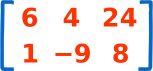
Matrices has columns and rows. In a matrice, the columns always goes up to down while the rows goes left to right. Heres a example:

2x3 Matrix

In this case, we will always count the rows first then the column. So as we can observe from the example, we can tell that it is 2 by 3.

Now we can start adding, subtracting and multiplying matrices. In my opinion, multiplying is easy when you get the hang of it.

Adding Matrices

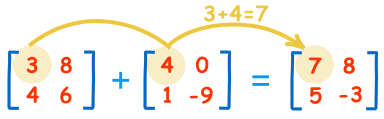
We are going to start by adding matrices. Adding matrices is almost identical to adding fractions. Heres a example to explain it:

Matrix Addition

As explained in the example, you just have to add the number in the same row and column for each number and you will get your answer.

Subtracting Matrices

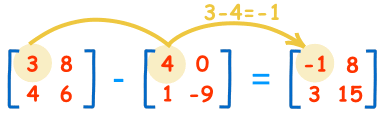
Subtracting is just exactly the same as adding matrices. Keep in mind that you still have to subtract the number in the same column and row for each number. Heres a example to explain what i said,

Matrix Subtraction

Multiplying Matrices

Multiplying matrices is a little bit more complicated. You need to count the rows and columns first before you can multiply. This is because the column in one matrice and the row in the other matrice can be different. A example is when a matrice is 2 x 3 while the other is 1 x 3, that will be impossible because the column in one of the matrice is different than the row in the other matrice. Heres a visual example to explain what i said:

If your results is this instead of 2 x 3 and 1 x 3 then it is possible. After you confirmed that it is possible, you have to multiply the number in one row by the column. Heres a example on how you do it.

Inverse Matrices

in my option, inverse matrices can be really confusing if you don’t understand how to do it. once you understand the ways and concept, its going to be easy once you know the concept. Here is a example question.

to solve this, you need to first find the determinant. to do that, you need to cross multiply which will get you (3)(5)-(2)(1) which is equal to 13. So the determinant will be 1/13. Next, you just have to switch the numbers and it should look like this.

After you’ve done that, you have to divide the new matrice by the determinant which is 1/13. After you did that, it should look a little something like this.

Reflection

Reflection is a type of rigid transformation in which the pre-image is flipped across a line of reflection to create the image.

We can reflect a image in a graph by applying and drawing the mirror line onto the graph provided by the question. After you did that, you will have to reflect the image according to the mirror line provided. Here is a example to explain how we can reflect.

Base on this example, the mirror line is x=0. To reflect, we can count how many blocks or units the shape is away from the mirror line. In this case, we will reflect shape A to shape B. Shape A is 2 blocks away from the mirror line. So this means we have to draw shape B 2 blocks away from the mirror line, but the shape has to be inverted.

A way that Mr Kichan told us to kind of “cheat” the system a bit is by literally folding the paper and see how the reflected image is like.

Rotation

Rotation is a concept originating in geometry. When you are told to rotate a shape, you might need a transparent plastic. You need a transparent plastic to draw the image on there and use a pen to hold the coordinates and turn the plastic depending on the question

Image titled Rotate a Shape Step 2

In this case, the center point will be (0,0). You will need the transparent plastic and draw the shape in the plastic using a marker. After that, you can use your pen and hold on the coordinates (0,0). You will then need to twist the paper according to the question. We are going to rotate it 90° anti-clockwise. It should look like this.

Image titled Rotate a Shape Step 5

Enlargement

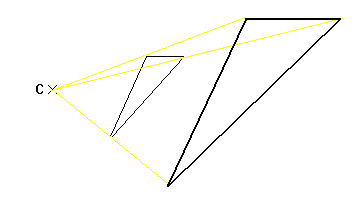
You need to enlarge the shape according to the scale factors. First, you need to draw a line from the center and enlarge the shape. If the scale factor is 2, draw a line from the centre of enlargement, through each vertex, which is twice as long as the length you measured. If the scale factor is 3, draw lines which are three times as long. After you did that, it should look like this.

Enlargement

evaluation of sets and probability

Recently, we learnt about sets and probability with our one and only teacher, Mr Kichan. Sets and probability is in chapter in our book. Probability is mostly about finding a probability of something in a set of something. A example is “what are the chances of drawing the three of hearts from a regular deck of cards”. A set is usually a collection of numbers or objects.

Probability

In a more advanced way to define probability is when you calculate how likely something is going to occur out of all possible outcome. An example question is when you throw a dice and you have to calculate the probability of rolling number five. The answer would be 1/6. This is because out of six possible outcomes, only one outcome gives out five which gives us the answer 1/6. This is already a example of a real life application.

Sets

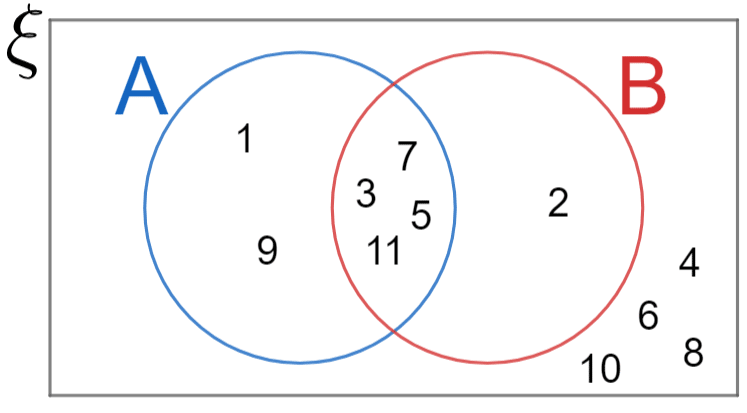
A set is a collection of numbers, for example, the prime numbers from one to ten are {2,3,5,7}. A set of numbers can be a subset of another set of numbers. When for example, set A is a subset of B, therefore means that all elements in set A is also in set B, but not necessarily vice versa.

Sets can be represented using a venn diagram. The circles represents the sets and their relationships with other sets. The numbers represent elements. Here is a example of a picture of a Venn diagram.

Image result for sets venn diagram

There are some ways we can use sets in our daily lifes. For example, thirteen boys all play either football or basketball or both, 8 boys play football and 10 boys plays basketball. How many boys plays both sports?

So first we come up with a equation which is (8-x)+x+(10-x)=13. We then need to calculate the value of x to find the number of boys who plays both sports. We can do this by combining like terms which will give us 18-x=13. You then solve it and the answer should be x=5.

“There are three types of lies — lies, damn lies, and statistics.” ― Benjamin Disraeli

So this is my 3rd week of sec 4. So far i learnt about statistics. This topic is all about mean, median, mode, range, IQR (interquartile range), box and whiskers and modal class.

So first, what is statistics? Statistics is the study of the collection, analysis, interpretation, presentation, and organization of data. In other words, it is a mathematical discipline to collect, summarize data. (url:https://byjus.com/maths/statistics/)

Anyways what we learnt in maths with Mr Kichan, we learnt how to use the calculator to find the mean, standard deviation automatically. So i am now going to teach you how to do this. I am going to teach you how to input a x and y table and how to find the mean automatically.

1.You need to first have a calculator.
2.Press “MODE SETUP”
3.then in mode setup, there are three options. comp, stat and table. We are going to use stat which is number two. So press number two
4.After you did that, you have to press number two which is A+BX
5.Now you should be able to see a table with x and y.
6.After you did all of that, it should look something like this

7. If your screen looks like this, you are on the right track
8.In your worksheet, you should have a table provided there.
Heres a example question.

Image result for x y table math
https://www.google.com/url?sa=i&source=images&cd=&ved=2ahUKEwioxOu35_DjAhVXfSsKHXh3DbUQjRx6BAgBEAQ&url=https%3A%2F%2Fmagoosh.com%2Fpraxis%2Fpraxis-math%2Fpraxis-math-practice%2Fpraxis-core-math-linear-equation-practice-questions%2F&psig=AOvVaw08QtAE5onc6l8ZIwf8lhgL&ust=1565268960006921

9. You then have to input that or the one in your worksheet in the calculator.
10.After you input it in the calculator, press AC
11. There should be just a blank screen with a 0 (zero although it looks like a o) (chill this is suppose to happen. Im not trolling you😂😂)
12.You then have to press shift 1.
13. After you’ve done this, there should be six options. Type, Data, Sum, Var, Reg and MinMax. We are going to use Var which is number four.
14.In Var, there are seven options. If you want to find the mean of x, then press number 2 which is x̄ .
14. After you pressed that, press the equal sign and you’ll get the answer.

So that is how you get the mean quickly without having to add everything and divide it with the number of elements.

Another thing we learnt is how to make a box and whiskers. So what is a box and whiskers? A box and whisker plot—also called a box plot—displays the five-number summary of a set of data. … In a box plot, we draw a box from the first quartile to the third quartile. A vertical line goes through the box at the median. The whiskers go from each quartile to the minimum or maximum. (url:https://www.khanacademy.org/math/statistics-probability/summarizing-quantitative-data/box-whisker-plots/a/box-plot-review )

So heres how to make a box and whiskers
1.First you have to arrange the number from the data from smallest to biggest
2.Next, you have to find the first and third quartile. the formula for first and third quartile is : 1/4(1+n)=answer
3.Then after that, you have to make a plot line with numbers already plotted there.
4.You then have to mark the first and third quartile and the median on the plot line.
5.And then you have to have to connect all of them into a square.
6.You then have to plot the smallest and largest number from the data.
7. Then you have to connect the plots to the square.

So that is how you make a box and whiskers. if you have any questions, comment down below and i’ll answer you

E-Journal 3: Speeding Through The 7 Chapters.

Hey guys! My name is Steven and this is my third journal, which is about me discussing the seven chapters i learnt in math throughout my year with my math teacher, Mr Kichan. In this blog, i am going to tell what i struggled with and how i overcame it.

Chapter 1: Numbers

In this chapter, we learnt a lot of things. There are tons of stuff we learnt like how to add, subtract, divide and multiply fractions and decimals
Here are a list of what I learnt:

  • How to use the calculator
  • How to write numbers in standard form
  • How to calculate speed, distance and time
  • Sequences
  • Percentage like how to find compound interest
  • How to convert fraction to decimal and decimal to fraction

To be honest, I can understand this chapter pretty well and it is quit easy for me aside from one topic which is standard form. I feel like it is hard for me to understand, memorize and master on how to convert equations to standard form. I don’t know why but its just very confusing for me. An example of a question is:

Turn 70000 into standard form.

I first didn’t know how to do this question. So I went through the book and read the examples with answers to help me answer this question. This is how you do it,

70000=7×10000

Answer=7×10^4

Chapter 2: Algebra 1

In this chapter, we learnt the contents of algebra which is more advance and more than chapter 1 in my opinion. Although it is more advanced than chapter 1, I feel like this chapter is more easier to understand for me than chapter 1. Though there are a lot of elements of algebra we learnt.

Here are the list of what I learnt in this chapter:

  • How to add, subtract, multiply and divide negative numbers.
  • How to solve linear equations
  • How to solve simultaneous equations
  • How to factorise and expand
  • How to solve quadratic equations

Although I said this chapter was easy, of course there are still some topics I don’t fully understand like how to factorise. To be honest, I understand how to expand and factorise but its just the amount of careless mistakes I make are ridiculous. I mainly cant fully understand how to solve simultaneous equations. I can solve some questions but if it gets advance, I cant do it. An example of the question is:

Factorising

x^2+2x-15

first I found that -15 is equal to -3×2 which means we can factorise it into (x-3)(x+2). And that is basically the answer

Chapter 3 : Mensuration

This chapter is all about area, surface area, perimeter, circles and triangles. I don’t really adore this chapter but I can manage this chapter really well considering it was very easy for me at least. This chapter includes a little content but a lot of understanding and formulas. Its like giving a homework which only has 3 numbers with 10 letters.

Here are the list of what I learnt in this chapter:

  • how to find areas for different shapes
  • how to find surface areas for different shapes
  • how to find perimeter for different shapes

To be honest, this chapter wasn’t hard at all and I can do pretty much any topic in this chapter.

Chapter 4: Geometry

In this chapter geometry, we learnt a lot about triangles, finding a side of the triangle using Pythagoras theorem. We also learnt to identify if a shape is similar to each other although they have different sizes.

Here are the list of what I learnt in this chapter:

  • Similarity
  • Pythagoras’ theorem
  • Symmetry
  • Circle theorems
  • Construction and loci
  • Nets  

Something I kinda struggled before was about circle theorems. I don’t know exactly why but I had problems on how to answer the questions relating to circle theorems. Although I didn’t understand this topic, I tried to asked Mr Kichan to explain to me about what you have to know about circle theorem. And right after that explanation, I was able to answer some of the questions from the book!

Chapter 5: Algebra 2

Chapter 5 is just the same as chapter 2. Both chapter are about algebra but with just different topics. In this chapter we learnt on how to make a specific subject in the formula to be the subject.

Here is a list of what I learnt in this chapter :

  • Changing the subject of a formula
  • Variation
  • Indices
  • Inequality
  • Linear programming

This chapter is also not a chapter I really like. I have a lot of problems understanding this part of the chapter. Chapter 2 which is algebra 1 was easy to start with. But when you go to this chapter, the problems and topic is more advanced.

Chapter 6: Trigonometry

In this chapter, we learnt how sine, cosine and tangent can be applied to find angles or length in a triangle. We also learnt how to find a bearing.

Here is a list of what I learnt in this chapter :

  • Right angled triangle
  • Sine, cosine and tangent
  • Sine rule
  • Cosine rule

In this chapter, I don’t understand on how to find bearings. No matter how much I try to find it, I still don’t understand bearings. Even up to this day I still don’t understand about bearings. If any of you knows anything about bearings, feel free to tell me down below in the comments 🙂

Chapter 7: Graphs

Ah…. Finally the last chapter. This chapter is another one of my hated chapter cause making graphs takes a long time and it gets annoying sometimes. This chapter is basically all about graphs. In this chapter, we learnt how to plot the points onto the graph to make the graph.

Here is a list of what I learnt in this chapter :

  • Drawing graphs
  • How to find gradients
  • Plotting curved graphs
  • The formula of y=mx+c

Although I hate this chapter, I don’t have a lot of problem doing problems for this chapter. This chapter is quite easy and manageable for me.

So this was my journey of sec 3. There was a lot of chapters for me to learn and I passed some and failed some. Over all this was a rough journey for me and I hope it isn’t for you.

E-Journey 1: Very Careless Math Mistakes I Made

Over my secondary 3 life, I made a lot of careless mistakes on math. I recently moved to core cause my very amazing math teacher Mr Kichan think it would be better if i stayed in core or else i’ll fail math. I mean like i agree and it was a right thing to do. Anyways i had a math test recently and it was called “Amazing Test”. I guess you can say Mr Kichan invented this. The Amazing Test was basically a test of a compilation of what we learnt from secondary 1 to 3. It wasn’t really hard but i had made some careless mistakes i hope i didn’t.

One of this mistake was this very simple question i manage to get it wrong on. The question was to write 248.367 to 2 significant figures and this is a picture of the question and my answer

Aw man come on. I know all of you are just doing a big facepalm right now. Yea i get it. Anyways what i wrote there was 248.36. I guess i got kinda mixed up.

Another one of my mistake is again a very simple question. The question asked to write 0.000186 in standard form and this is a picture of the question and my answer.

I really don’t know how i managed to get this question wrong. I mean like both the answer leads to 0.000186 but it wasn’t in a standard form.

This question is one of the worst careless i will probably ever make. The question basically gave us a and b and what number a was and what number b was. We needed to just substitute a and b with “a^2+b^2” which is very simple. This is the question and my answer

This is probably the worst mistake i made cause i forgot to put in brackets in the calculator which is very dumb of me to do.